

I’ve ridden through mud that swallowed 30-inch tires to the axles. I’ve winched out of bogs that looked solid until they weren’t. I’ve destroyed two sets of brake pads in a single weekend and seized a CVT belt so badly the housing melted. So when SWM sent me the Trailhunter 1000 MUD Edition with a note that said “try to break it,” I took that as a personal challenge. Three days later, soaked to the bone and grinning like an idiot, I had to admit: they built something that doesn’t break the way mud machines usually break.
The MUD Edition starts with the standard off road side by side platform — the 1000cc DOHC parallel-twin that’s powered the Trailhunter line since its introduction — and adds a package of factory modifications that would cost $3,500 to replicate in the aftermarket. The headline upgrade is the snorkeled CVT intake and exhaust, routed through the front roll cage to an intake positioned at roof height. Standard Trailhunters have the CVT intake behind the left-side body panel at approximately 32 inches above ground. The MUD Edition raises it to 72 inches. In practical terms, that’s the difference between sucking water into your belt housing at the first creek crossing and being able to ford hood-deep water without a second thought.
Day One: The Beaver Pond Gauntlet
My testing ground was a 600-acre tract of bottomland in southern Georgia that I’ve used for vehicle evaluation for fifteen years. The terrain includes three beaver ponds, two miles of black gum swamp, and a clay-bottom creek that alternates between ankle-deep and chest-deep without warning. Temperature was 42°F with an intermittent drizzle — perfect conditions for mud that lubricates the surface while grabbing anything that sinks past the first six inches.
The MUD Edition rides on ITP Cryptid tires — 30 inches tall, 10 inches wide in front, 12 inches wide in the rear — with a tread pattern that looks like someone designed a paddle tire and a mud tire had a baby. The lugs are 1.5 inches deep and spaced widely enough to self-clean at wheel speed, which is the single most important characteristic of a mud tire. Tires that don’t self-clean become racing slicks the moment the treads pack with clay, and racing slicks don’t move through swamps. The ITP Cryptids shed Georgia red clay at 8 mph in second gear, maintaining forward progress in conditions that would have required a winch with the stock Trailhunter’s 26-inch all-terrain tires.
The electronic locking front differential — standard on all Trailhunter 1000 models — engaged with a soft clunk at the push of a handlebar-mounted button. Once locked, the MUD Edition crawled through a section of the beaver pond that I’ve never cleared without winching. The secret is weight distribution: with the radiator relocated to the front rack (another MUD Edition mod) and the winch mounted low on a reinforced bumper plate, the front-to-rear weight balance shifts to 52/48 compared to the standard Trailhunter’s 48/52. That four-point shift toward the front axle means the front tires bite into mud instead of floating on top of it.
Day Two: Heat Management Under Load
Mud riding is abuse of machinery. Continuous high-load, low-speed operation generates heat that the cooling system was never designed to dissipate at walking speeds. The CVT belt in particular suffers — sustained high-torque, low-ratio operation can spike belt temperatures past 300°F, at which point the rubber compound begins to degrade. The MUD Edition addresses this with two modifications: the snorkeled intake pulls cooler, cleaner air from above the vehicle, and an auxiliary CVT cooling fan — thermostatically controlled and waterproofed to IP68 — kicks in when belt housing temperature exceeds 200°F.
I monitored belt temperature through the Smart Rider app throughout day two’s most demanding section: a 400-yard mud flat where forward progress required full throttle in low range for 23 continuous minutes. Belt temperature peaked at 238°F and stabilized there. For context, I’ve measured 310°F on a stock Can-Am Outlander in similar conditions, and that belt was smoking by the time I stopped. The Trailhunter’s CVT engineering — both the cooling system and the belt compound itself — kept operating temperatures within the safe zone, and the belt showed no signs of glazing or uneven wear when I inspected it that evening.
The Radiator Relocation: Simple Genius
Anyone who’s spent time in deep mud knows the standard ATV radiator placement — low and forward, behind the front grille — is a design flaw inherited from sport quads that never should have migrated to utility machines. Mud packs into the radiator fins within the first ten minutes of serious riding, coolant temperature spikes, and you’re either stopped waiting for it to cool down or replacing a head gasket. The MUD Edition moves the radiator to a high-mount position on the front rack, behind a mesh guard that’s coarse enough to shed mud but fine enough to stop debris. Coolant temperature never exceeded 205°F during three days of continuous mud operation — a number that would make any mud rider nod in respect. The standard Trailhunter radiator position would have clogged within the first hour.
The 1000cc side by side platform itself deserves credit for the thermal headroom. The 1000cc DOHC twin uses a semi-dry sump oiling system with an external oil cooler that adds approximately 1.5 quarts of additional oil capacity compared to a conventional wet sump. More oil volume means more thermal mass, which means slower temperature rise under sustained load. Combined with the relocated radiator and the auxiliary CVT fan, the MUD Edition has a cooling system that’s genuinely engineered for mud riding rather than adapted to it.
After three days, I’d put 14.7 hours on the engine, burned 23 gallons of fuel, and pulled the winch cable exactly twice — both times to extract other people’s vehicles. The MUD Edition’s only flaw is the factory skid plate, which uses 3/16-inch aluminum that will take a beating but benefits from an aftermarket UHMW upgrade if you’re riding rock-strewn mud trails. That’s a $400 fix, and it’s the only thing I’d change.
There’s an old saying among mud riders: “If you’re not winching, you’re not trying hard enough.” The Trailhunter 1000 MUD Edition makes that saying obsolete. It’s the first factory mud machine I’ve tested that doesn’t require an apology. SWM didn’t just bolt mud tires onto a standard ATV and call it a special edition. They re-engineered the cooling, breathing, and weight distribution to create a vehicle that performs in mud the way it was always supposed to — without drama, without overheating, and without leaving you ankle-deep in swamp water wondering why you didn’t just stay home.
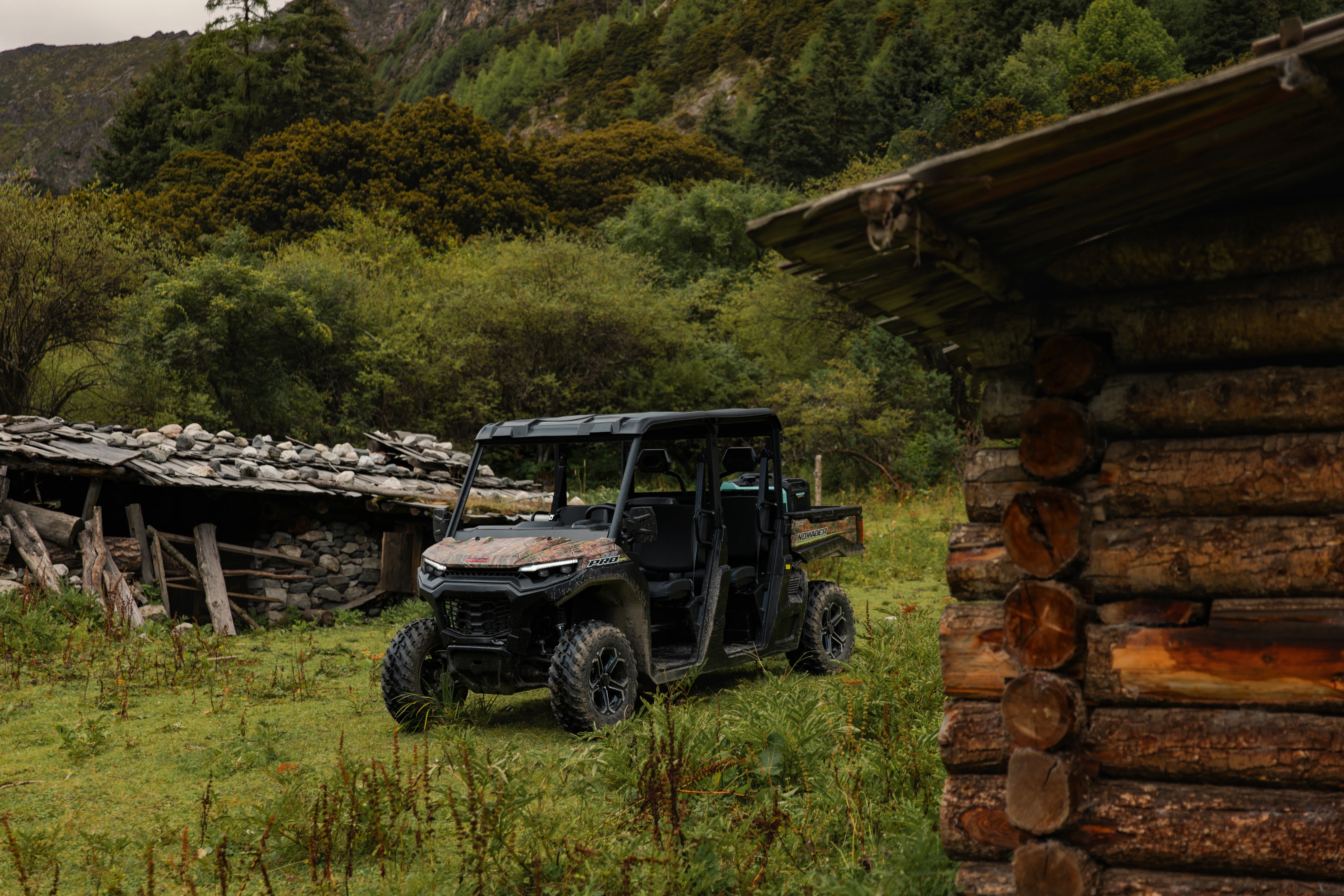
The mud-specific engineering on the Trailhunter 1000 MUD Edition goes deeper than the tires and the snorkel. SWM’s engineers relocated the CVT intake and exhaust vents from their standard positions low on the chassis to a high-mounted configuration that draws air from inside the front storage compartment — a location that stays dry even when the vehicle is hub-deep in water. The CVT belt housing was fitted with an additional drain plug positioned at the lowest point of the case, allowing water that does enter to be evacuated without disassembling the transmission. The electrical connectors throughout the chassis were upgraded to IP67-rated sealed units with dielectric grease pre-applied at the factory, and the ECU itself was relocated from under the seat to a waterproof enclosure behind the dashboard. These changes represent an honest engineering response to a real use case: mud riding is popular, mud destroys vehicles that are not designed for it, and the difference between a vehicle that survives repeated mud immersion and one that does not is a series of small, unglamorous design decisions that cost very little to implement at the manufacturing stage but are enormously expensive to retrofit. The MUD Edition’s ability to emerge from three days of swamp abuse with nothing more than a muddy exterior is not a marketing claim — it is the predictable result of engineers who understood exactly what mud does to a vehicle and designed accordingly.
